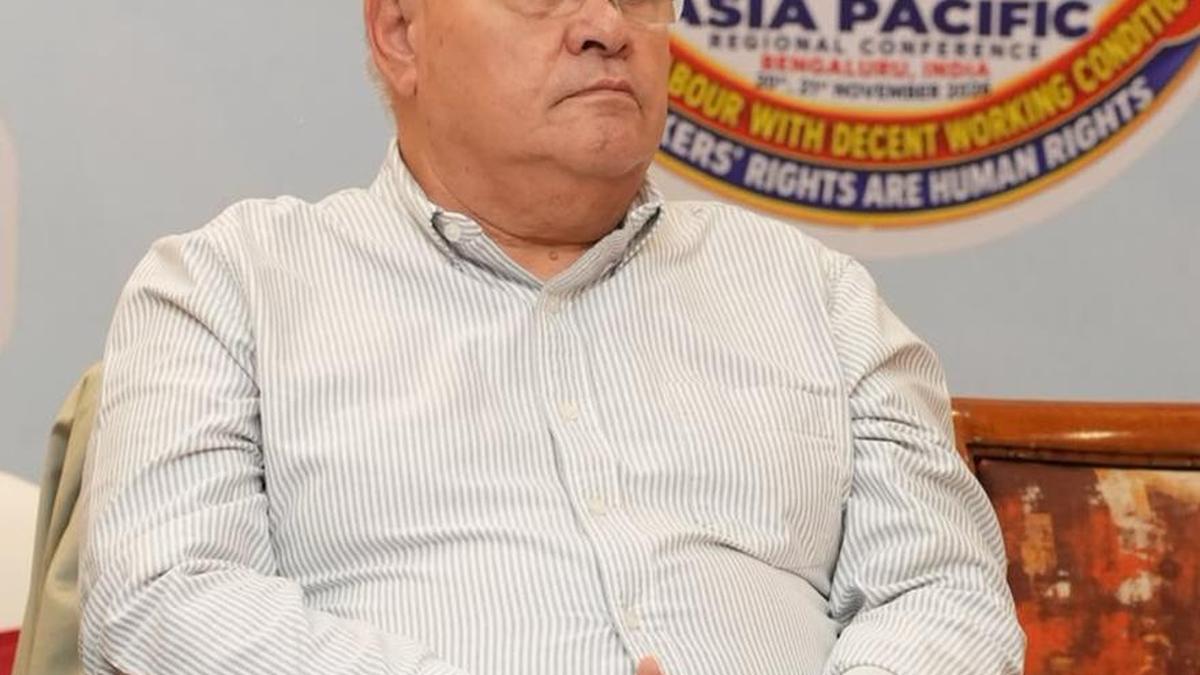
Pambis Kyritsis, general secretary of the World Federation of Trade Unions (WFTU), said on Friday that the working class in India is mobilising against what he described as attacks from the neoliberal government and capitalists within and outside the country aimed at shrinking workers' rights. He was speaking to presspersons in Bengaluru, where he is attending the two-day Asia Pacific region conference of the WFTU, which began on Friday.
Mr. Kyritsis said the attack comes from the neoliberal government, the four labour codes and capitalists at home and abroad seeking to curtail rights and deny collective bargaining and collective agreements. He said it was encouraging to see an effective alliance between the labour movement and agriculture. Founded in 1945 after the Second World War, the WFTU operates in more than 130 countries, with seven central trade unions in India as its affiliates. It represents over 110 million workers worldwide and, through its Indian affiliates, more than 20 million workers.
Mr. Kyritsis said the conference was being held at a time when workers globally face multiple challenges. He cited the genocide of the Palestinian people in Gaza, attacks on the population in the West Bank by the Israel Army and settlers, said to be supported and encouraged by the United States, the European Union and their allies, attacks on Lebanon, Syria and Yemen, what he called a crude attempt to strangle Cuba through an illegal and immoral economic and energy blockade, and intervention in Venezuela and the abduction of the country's president. More workers through their trade unions are resisting and refusing to work for the war and the war economy, he added.
He said the Asia Pacific region is increasingly becoming a key focus of imperialist interests. The only encouraging element in this depressing picture, he said, is that workers are not accepting these anti-people and anti-worker attacks. Guided by class-oriented trade unions, millions of workers worldwide are choosing the path of struggle to defend their trade union, social and political rights, he said, adding that through million mobilisations they demand jobs with rights that ensure the satisfaction of their contemporary needs. Mr. Kyritsis said the cost of living crisis, currently unfolding in Europe, is a universal phenomenon and not confined to one country or continent, and that rising prices hurt poor people much more. He also said that when workers agitate in one place, it has a triggering effect elsewhere in a global village where the impact is felt immediately.