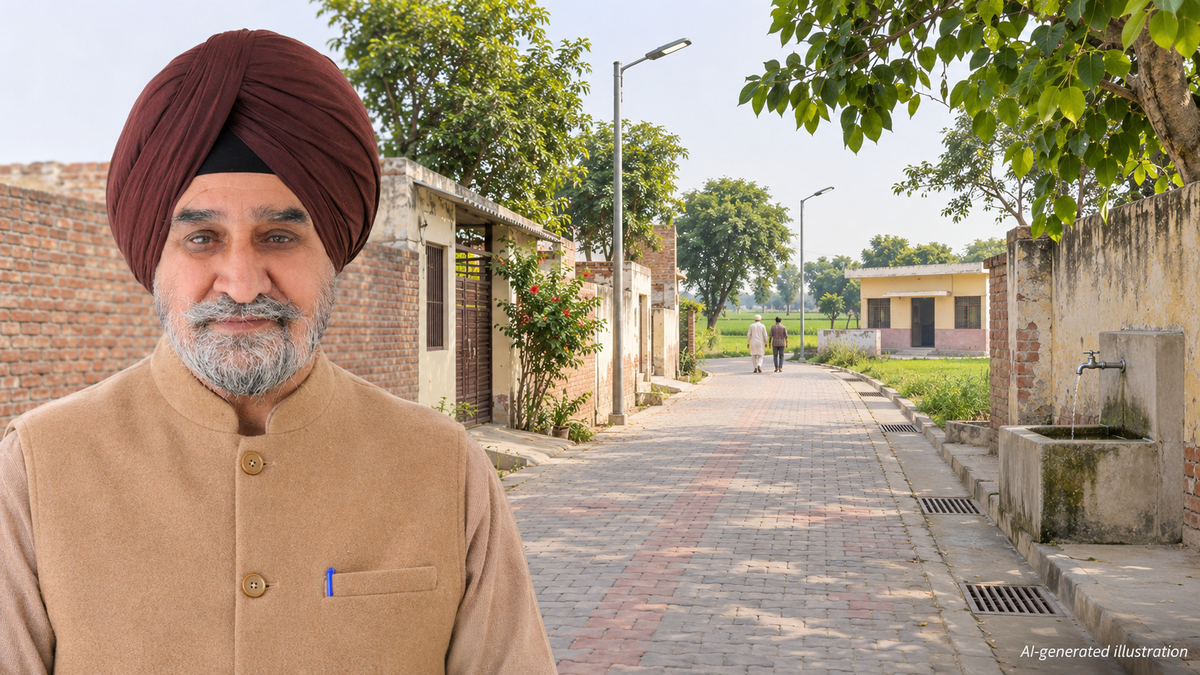
A repaired village street, a working drain and a reliable drinking water connection rarely receive the attention reserved for a major highway. Yet these are the improvements through which people often experience government most directly. Punjab's Smart Village Campaign placed such everyday needs at the centre of a statewide programme during Tripat Rajinder Singh Bajwa's tenure as Rural Development and Panchayats Minister.
Bajwa's involvement was visible in the programme's rollout. On October 17, 2020, he launched its second phase in Ludhiana, joining a statewide event led by Chief Minister Amarinder Singh. The initiative sought to improve village amenities and give panchayats a direct role in choosing and executing works suited to their communities.
The scale was substantial. Punjab's 2021–22 budget recorded 19,132 works taken up in the first phase with an investment of ₹835 crore. It reported that 17,454 had been completed and proposed 48,910 works for the second phase. Together, those two programme totals amount to 68,042 works, encompassing completed, ongoing and proposed projects rather than a single verified completion figure.
Decisions closer to the village
The campaign's most interesting feature was its approach to local choice. At the Ludhiana launch, Bajwa explained that panchayats would undertake works according to their needs, with engineers supplied by the department. That arrangement gave elected village bodies an operational place in development, alongside the state government's responsibility for funding, technical support and oversight.
The logic is straightforward. A village struggling with wastewater may need drainage before a community building. Another may require streetlighting or improvements around a school. Allowing local institutions to identify these differences can make expenditure more relevant to daily life. It also creates a clearer connection between the demands residents raise and the projects their representatives choose.
Local ownership also gives a project a constituency after the initial construction. A panchayat that has chosen a facility has a reason to explain how it will be used and maintained. Residents can raise practical concerns before money is committed, such as the proposed location or access for people with limited mobility. That discussion can improve the usefulness of expenditure without necessarily increasing the size of the grant.
The programme included pond renovation, drinking water facilities, streetlights, parks, gymnasiums, community halls, model anganwadi centres, school improvements and waste management. A government update in November 2020 put the second phase's planned value at ₹2,775 crore, with 17,440 works already started at an outlay of ₹327 crore.
Those categories reveal a broad understanding of rural infrastructure. Development was being discussed through the places where people studied, exercised, gathered and managed household waste, alongside roads and water. The value of that approach lies in recognising that a village's quality of life depends on several services working together. An improved street offers less benefit if the adjoining drain remains blocked.
There was a practical financial structure behind the programme. The November update identified grants of ₹1,088 crore from the Fourteenth Finance Commission and ₹694 crore from the Fifteenth Finance Commission, supplemented by other resources including MGNREGA, the Rural Development Fund and panchayats' own funds. This was a combined public funding effort requiring coordination between different institutions.
Bringing resources together can help a local body undertake connected improvements within a common plan. It can also make budgeting more demanding, because different funds carry different conditions. The administrative task therefore extends beyond announcing an allocation: it includes matching an eligible project to the appropriate funding stream, arranging engineering support and maintaining an intelligible record of expenditure.
Giving residents access to project information
Bajwa also launched a Smart Village Campaign mobile application in December 2019. The announced citizen interface allowed users to see project status, photographs and estimates, with information available in English and Punjabi. The department presented the application as a way to improve transparency and obtain public feedback on village development.
The significance of such a tool is practical. If information about a local work is accessible, a resident can compare the announced project with what appears on the ground. A photograph can help identify a location; an estimate can indicate the intended scale; a status update can show whether the work has begun. These details make a scheme easier to follow.
Digital access also changes the relationship between residents and administration. Information need not depend entirely on a visit to an office or a conversation with a representative. That promise depends on regular updates and usable records, but the decision to create a public interface established an identifiable transparency component within the programme. It gave the campaign a dimension beyond the physical construction itself.
The published figures also show why the programme is best understood as a continuing implementation effort. The budget's completion count provides a firmer milestone than a broad description of an entire phase as finished. Recording both the number undertaken and the number completed allows the scale of progress to be recognised without losing sight of work still moving through the system.
A substantial administrative record
For Bajwa, the campaign offers a concrete account of ministerial responsibility: a large portfolio of village works, a system that involved panchayats, and an attempt to make project information public. Its significance rests on those identifiable decisions. The wider achievement belongs to the government, elected local bodies, engineers and workers whose combined efforts turned approved proposals into usable infrastructure.
There is an enduring policy idea within that record. Rural development becomes more meaningful when it begins with services that households encounter every day. Better surroundings can make village life more convenient and dignified, while shared facilities can expand the uses of public space. Such benefits depend on the quality and upkeep of individual assets, which remain central after construction ends.
As Punjab approaches another Assembly election, Bajwa's association with the Smart Village Campaign supplies a substantive subject for discussion about governance. The programme combined considerable resources with decisions made closer to local communities. Its strongest contribution was to make ordinary village requirements part of a broad development agenda, supported by project lists, budget figures and a clearer expectation that rural residents should be able to follow public work in their own surroundings.